Friday, September 21, 2012

Nike Dragon Sauce


 Thanks to Kristina Gehrig- Material Designer - Footwear, and Brett Holts- Track and Field Product Line Manager- at Nike what was a slim chance became a reality within 2 days when I had the idea I would love to get my hands on some Olympic trainers to pursue a concept  about the methodology of designed pattern and relief on modern trainers and how that relates to preindustrial methods of pattern and design transferred between mediums. With the Olympics here in London it seemed like the perfect time to move the idea forward. I didn't have much luck finding anyone with contacts here in London so I asked my partners son's girlfriend who is a designer for Nike in Oregon if there was any chance of getting some olympic trainers. Well this girl moves fast and literally within 2 days Brett who was in London representing Nike 2012 Olympic Track and Field Innovation emailed me to set up a time to come to my studio at the V&A and bring me the goods. Needless to say I was jump up and down excited and blown away with the generosity of Nike and the exuberance these young talented designers had for what must have seemed like a pretty quirky request.

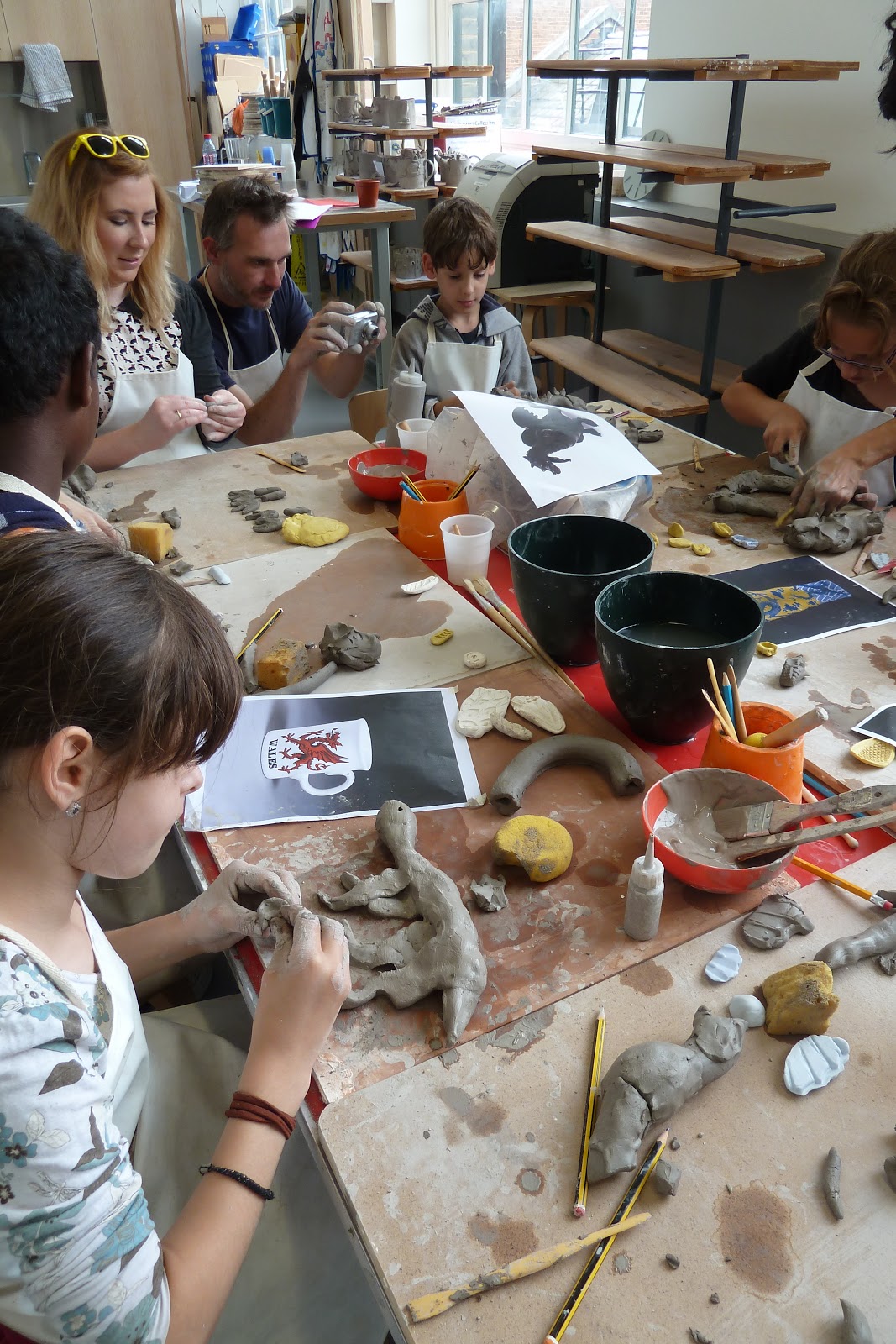
Despite the extraordinarily fast response by Nike my ideas had to simmer for a bit because of the immediate demands on my time in the studio for the video projects. But meanwhile there was an opportunity to get the ball rolling by relating the concept to a  young peoples workshop I had scheduled    on looking for dragons in the V&A's collection and coming back to the studio to create dragons in clay. As soon as I saw these amazing designs for the first time in person it became clear the elements would be perfect inspiration to create some super "Flyknit" dragon skin.

In order to recreate pieces of the patterns in the medium of clay I needed to take 'sprig moulds' directly off the shoes that the clay could then be pressed into. The issue then became how to keep the shoes in good condition while getting impressions of the incredible variety of relief on the soles and uppers -each having a distinctive character and methodology and most importantly story behind the design.
This required an upgrade of my silicon based molding putty to one that I was turned onto by a collaboration with V&A conservator Hanneke Rammaker who is part of an astounding conservation department here. I  tried a small sample she brought me and indeed it completely released from the fabric so I ordered my own- of course it had just sold out so it took about a week to get it in which was another crimp in my tight timeline here- it was well worth the wait. This flexible high tech putty added other layers of manipulation that could be used to transform the patterns into clay.

So the dragon workshop became the first manifestation of my trainer pattern pursuit and it would be 7-10 year olds pursuing it for the first time. I made a large pot inspired by the anthropomorphic form shared between two pieces from the V&A collection a 13th century London Jug (best pot ever made), and The Auspicious Cloud of the Oriental 2010 by Laurence Xu.
Left to right-Nike Flyknit Racer, Zoom Victory Elite, Zoom Superfly R4, Zoom Long Jump ( I also got a pair of Zoom Rotational but since the bottoms are completely smooth save the swoosh I didn't pull those out)
In the background are 2 amazing works from the V&a collections a 13th century London jug maker unknown and Laurence Xu's The Auspicious Cloud of the Oriental
A group of young people from Triangle Adventure Playground/Metropolitan Housing Association and the amazing dragons they created! 

some executive decisions needed to made and a few finishing touches, Reino Liefkes senior curator of ceramic and glass, Kate Quinlan curatorial intern and art student at the National College of Art and Design Dublin, and Tracy Friend also a maker and my wonderful assistant for the day. 


I have had some interest in the methodology used to create pattern and relief on English white salt glazed stoneware. I chose two great examples for my cases both are block moulds meaning the thickly cast or press molded positives that are made from the original moulds taken from the original model. One for a sauce boat and one a shell like teapot.  These blocks were fired high with very little salt as to keep the surface relief crisp for subsequent moulds to be taken as the old ones ware or perhaps these were used in the industry to sell to various potteries as ready to cast models for production moulds- any thoughts?

So what do Nike Olympic trainers and 18th century English white salt glaze sauceboats have in common? The connection I was seeing between these patterns and 21st century trainers is where it can get tricky and complicated but it is clear in this case a picture may be worth 1000 words.
Zoom Superfly, sauceboat block mould and my porcelain test sprigs off the trainer heel. 


Silicon rubber mould bisque porcelain impression bisque London clay impression.

Yes London clay so this story will continue in my next post so stay tuned


Friday, September 7, 2012

KEEP BARRACK'N


I have purposefully avoided any news at home on politics but had to hit the pause button to hear the President Barrack the House last night at the DNC!

Tuesday, September 4, 2012

Quiet On The Set


The first video shoot  revolved primarily around the making of a delft puzzle jug which I described preparations for in an earlier post. In addition we filmed the beginnings of making an 18th century agateware pectin shell teapot literally from start to finish. Those who are familiar with my 'experimental archeology' may know the article in Ceramics in America 2003 Rob Hunter and I coauthored that features my work on the rediscovery of this technique.  The example I chose from the V&A collection I exhibit alongside an 8th-century Chinese agate wine cup to illustrate's Rob's observations that the 18th-century Staffordshire technique was clearly derived from Chinese antiquity. Leave it to the V&A to have more than one example of each of these objects to make the point!

While on the subject of my cases I want to acknowledge the highly professional label installation that took place about a week after the installation of the objects. Clearly Phil Collett and Keith Hartnell take their jobs very seriously ( no really they do) and for me it really was kind of a big deal - well done!

The puzzle jug video went semi well -excellent actually- the videographer Jurriaan Booij has been amazing and I love when the caliber of work that has gone into the preparation and making is matched or exceeded with the artistry in filming and/or photography. I have had the pleasure of that experience many times doing photo shoots for CIA with Gavin Ashworth who also shoots my contemporary work.
We did have some drama when at a critical moment the pot fly's off the wheel, pretty funny but made the last bit a little tricky. The sacrificial puzzle jug can be seen on the table a 'bit' worse for wear.
Jurriaan Booij the videographer, the sacrificial puzzle jug is in the background
The first part of the agate video begins at the beginning so I found myself unexpectedly charged with needing to create original models for the teapot, spout, lid and finial to cary out a start to finish approach  . Meanwhile all the various metallic oxides, dry clay formulas (which are hard to come by) had to be found ordered and delivered and then made into the varied clays of iron, manganese, and cobalt then tested and reformulated and tested again fortunately I got it in 2 attempts. The blue ball clay available here made a nice addition and the red iron oxide seems much better that what I get in the US.
Of course a glaze formula had to be made- enter in the last 5 kg of gerstley borate in the country from Bath and I needed to replace a very stable but low temperature frit I use in the US that there is no direct equivalent for here. Challenges abound but again what I could do much more directly in the studio provided me with new insight into the ceramic materials industry here and how the vast historical footprint of potteries in Britain is clearly evidenced in the approach to manufacturing raw materials which always influences the approach to making.


This image is a hint into the eureka moment we had while filming which I will 'unpack' in an upcoming post.
The lovely agate teapot from the V&A's collection in my case.

Wednesday, August 29, 2012

Billingsgate or Bust

One thing I had my mind set on was going to Billingsgate Fish Market for inspiration and crustaceans. As part of my work in casting from life or natural objects. This techniques is incorporated in my junk teapot series. Dragon Junk at Yale University Gallery, Octopus Junk here at the V&A and Koi Junk at Seattle Art Museum all use elements cast from natural shells and sea life. Inspired by my long time interest in Bernard Palissy and by the work I have done on the 18th century American porcelain pickle stands produced in Philadelphia by Bonnin and Morris so called 'life casting' is an art that i feel has new relevance in the 21st century. I thought i could expand my repertoire  or at least get some shrimp for the barbie.
Only one problem Billingsgate opens about 4 am and closes around 8:30 and is not easy to get to-enter my trusty friend and fellow adventurer Rod Jellicoe who is ready for anything so game on.


So I gathered a few perishables and headed back to South Kensington Rod took the scenic route which was risky considering the cargo in the back of his Volvo!


Once we made our way back to the V&A time was of the essence to try to make some molds of baby octopi and a lobster claw that I basically picked up off the floor.


BBQ master Rod Jellicoe

Executive chef Gary Atkins looking pretty pleased with Rod's technique so far!
Sunday BBQ was a fantastic finish to our Billingsgate adventure

Sunday, August 26, 2012

Marathon

     Though not an olympian I have had my own marathon of sorts and needless to say the work in the studio has taken precedent over keeping current with the blog so I will be channeling Mo to catch up since so much is happening.

It took much more time than I expected to resource and get in all the clays, glaze materials metallic oxides etc. It became clear that I would need to recreate the highly specialized and specific material and technical concerns of my studio to make what is needed for the 3 videos on my work in preindustrial ceramic technology I'm doing while here.

Navigating the surprising differences between English and American ceramic materials was not something I anticipated but it has been a strange and wonderful journey. Thanks to the great people at Bath Potters Supplies, Pottery Crafts, Valentine Clays and CTM Potters Supplies I have the likes of everything from industrial porcelain to euturia marl and Mike at Bath sent me the last 5 kg of Gerstley Borate in the UK. I started making and testing things right away with what was on hand and as things came in since my first video on making a puzzle jug was within 2 weeks of arriving.


First bisque in the large kiln 

Little test kiln sent from heaven!

In order to do a puzzle jug video you have to be able to make a puzzle jug! The clay I have at home for delft is one that is not easy to replace, consistency is very important to a form like this that has a refined
shape and requires a hollow rim and thinly potted to enhance the piercing around the neck.

I had surprising trouble getting a clay to work well most of the english clays came very soft and when doing a video you don't want to get three quarters of the way through and lose the piece at the critical point. In the end I had stiffen the clay up which of course has to be done gradually or you end up with a worse problem different consistencies ie lumpy clay.

The wheels were also a consideration since heel down on my wheel of 25 years is stop and heel down on the larger wheels here is go real fast. That can be a problem- again at a critical moment you press your heel down to stop visa vi habit and the pot fly's off the wheel. No worries they had 2 wheels that were much like what I have at home but they had not been used since purchased so the pedals were very stiff and you had no control between slow and fast. All I needed was a wrench but in an organization this big you need to put in a request to Janet (most helpful ever) at the Estate Help Desk and then they will schedule a technician to come and investigate. The good news is the Help Desk comes by it's name honestly- they are a huge help and are very responsive to requests! With one turn of a wrench I was in business and now it was time to make puzzle jugs, 4 or 5 actually as you need to have ones in different stages of ready to film all parts of the process in one day- and for screw ups which so far had been abundant.

 These little things were not so little and what I could do with some ease in the studio became a lot of hours of making it work as Tim Gun would say.


Comparing my first attempt to the original Liverpool puzzle jug I selected for the case
and the film which proved to be a challenge and a really great piece.

Friday, August 10, 2012

Field Trip to Hampton Court


Hampton Court is known for many things, to me the name shared by the city where I was born and raised and now have my studio Hampton Virginia. My dad The Honorable Henry D Kashouty presided over the general district 'Hampton Court' for thirty years and though a man's house is his castle THE Hampton Court Palace does not refer to our humble abode but of course the incredible English treasure  Home to King William and Queen Mary who chartered my alma mater and that of my father and mother before me The College of William and Mary. So a visit to Hampton Court Palace was a must.
 Notwithstanding all the connections from across the pond of particular interest to ceramic historians are the magnificent Dutch delft flower containers designed for William and Mary by noted architect Daniel Marot which were extraordinary to see in context. And of course the V&A being the the best place ever has an exquisite 'Greek A' factory tulip pyramid on display in room 145  I can adore daily as well as the over the top delft 'milk pans' from which the clotted cream must have been even too heavenly for God.
In the last two weeks Hampton Court Palace has been the center of Olympic activity from running the flame through the garden maze to the destination for the olympic cycling events. Part of a wonderful convergence of history and making history going on all over Britain.

rob took some amazing pictures at hampton court i'll add the best link to see asap


nice jugs
nice racks (sorry)

Was lost in the great halls for a bit but finally found my niche!